



Vertical CNC Lathe vs Horizontal: Which Fits Heavy Parts Better?
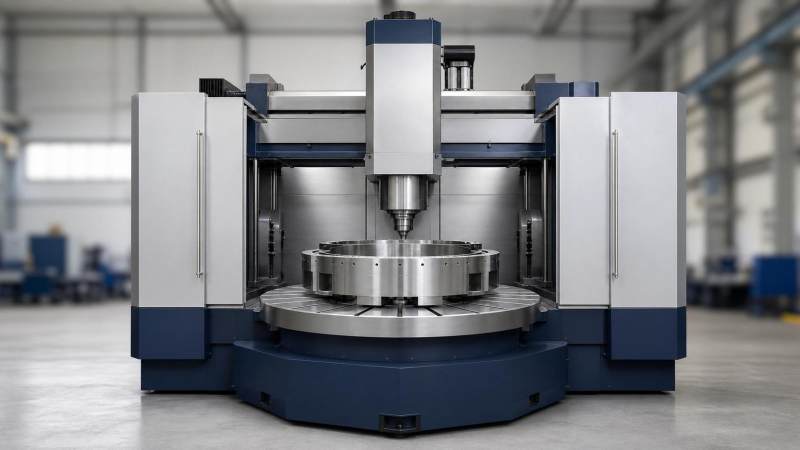
Choosing between a Vertical CNC lathe and a horizontal lathe becomes critical when part weight and diameter start driving machining risk. In heavy-part production, machine layout influences more than footprint. It affects clamping security, thermal behavior, chip evacuation, loading methods, and the consistency of finished tolerances.
That is why the comparison matters across machine tool investment decisions. A layout that works well for medium shafts or general turning may struggle with large rings, valves, flanges, wheels, or energy-sector components. The better option depends on how gravity interacts with the workpiece during the entire machining cycle.
Why machine orientation changes the result
A Vertical CNC lathe holds the workpiece on a horizontal table, with the spindle axis standing upright. The part sits under its own weight, which often improves balance for large diameters and high-mass blanks.
A horizontal lathe rotates the part around a horizontal spindle. This format remains highly effective for long cylindrical work, especially when shafts, rollers, and tubular parts need support across their length.
For heavy parts, the key question is simple. Does the part benefit more from being supported from below, or from being supported along its axis? That distinction shapes the rest of the decision.
Where a Vertical CNC lathe usually has the advantage
A Vertical CNC lathe is often the stronger choice for oversized, heavy, and relatively short components. Gravity helps seat the part on the table instead of pulling it away from the chucking system.
This is especially valuable when machining castings or forgings with uneven mass distribution. Setup becomes more predictable, and the risk of sag-related distortion is reduced.
Typical strengths
- Better support for large-diameter workpieces with high face weight
- Safer loading with overhead cranes for bulky parts
- Improved stability during interrupted cuts on heavy cast surfaces
- Lower tendency for deflection in short, wide components
- More efficient use of floor space for large swing capacity
In practical terms, a Vertical CNC lathe often fits brake drums, bearing rings, turbine casings, wheel hubs, large flanges, and valve bodies. These parts are not only heavy. They are awkward to hold in a horizontal orientation.
When horizontal lathes still make more sense
Horizontal lathes remain the preferred option for long rotational parts. If the workpiece length is a major variable, tailstock support, steady rests, and bar handling options become more relevant than table loading.
They also tend to suit production environments where part families share similar shaft-like geometries. In those cases, cycle efficiency can outweigh the structural benefits of a Vertical CNC lathe.
Better-aligned applications
- Long axles, spindles, rollers, and hydraulic rods
- Parts requiring support between centers
- Jobs with frequent shaft turning and threading
- Cells already built around horizontal automation flow
The point is not that horizontal lathes are weaker. They are simply optimized for a different mechanical problem. Heavy weight alone does not automatically favor a Vertical CNC lathe if the part is long and slender.
Heavy-part evaluation factors that deserve closer attention
Machine orientation should be judged against the real cutting conditions, not just the workpiece drawing. Several factors usually separate a sound decision from an expensive mismatch.
This comparison becomes more useful when paired with material data, blank condition, expected stock allowance, and tolerance stack. A Vertical CNC lathe may look ideal on dimensions alone, yet tool access or multi-operation flow can still change the outcome.
Current industry concerns behind the comparison
Heavy-industry machining is under pressure from tighter delivery windows and rising quality expectations. Scrap on a high-value casting is far more expensive than lost time on a smaller turned part.
At the same time, larger workpieces are appearing in wind power, mining, rail, shipbuilding, and energy applications. These sectors are pushing machine buyers to focus on rigidity, repeatability, and safe handling before headline spindle speed.
That is one reason the Vertical CNC lathe keeps gaining attention. It aligns well with the need to control mass, not just metal removal rate.
How to make the decision in real projects
The most reliable approach is to score the machine against the dominant part family, not the occasional exception. A plant that processes mostly wide, heavy housings should not choose around a few shaft jobs.
Useful decision questions
- Is the part heavy because it is large in diameter, or because it is long?
- Will gravity help seating, or create alignment issues?
- Does the setup need frequent crane loading?
- Are interrupted cuts and imbalance common?
- What matters more: swing capacity or between-centers support?
- Can the selected layout simplify inspection and secondary operations?
For many heavy-part programs, a Vertical CNC lathe delivers the cleaner answer because it reduces setup strain and supports better mass control. For long rotational parts, horizontal models remain the more natural platform.
A practical next step
The strongest decision usually comes from mapping actual parts by diameter, length, weight, and loading method, then matching those numbers to machine structure. That process quickly reveals whether a Vertical CNC lathe is a strategic fit or a niche addition.
Instead of comparing layouts in general terms, build a shortlist around your heaviest recurring workpieces, expected tolerances, and handling limits. The right machine is the one that keeps heavy parts stable from loading to final pass.