



CNC Vertical Lathe Benefits for Valve, Flange, and Ring Machining
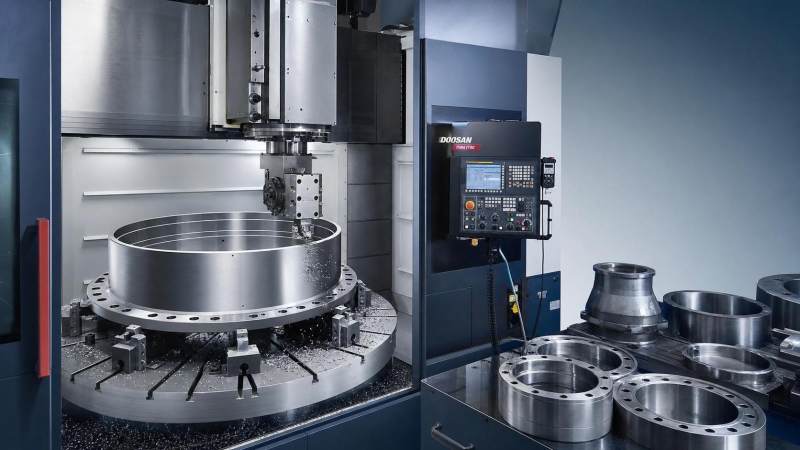
For valve bodies, flanges, and rings, the machining method affects more than cycle time. It also shapes dimensional stability, surface finish, and handling safety. In many heavy-duty turning tasks, a CNC vertical lathe stands out because the workpiece sits naturally on the table, not against gravity. That structural difference matters when parts are large, thick, and difficult to clamp with confidence.
Why the vertical layout matters
A CNC vertical lathe positions the spindle and cutting system around a vertically mounted worktable. The workpiece is supported from below, which reduces the risk of sagging during setup.
That is especially useful for circular components with large diameters and significant weight. Valves, flanges, and rings often fall into this category, even when their wall sections vary.
Compared with many horizontal turning setups, the vertical arrangement can simplify loading, improve balance, and make clamping behavior more predictable. These points become more important as part size increases.
A better fit for gravity-sensitive workpieces
Large rings and flanges can deform slightly if support is uneven. On a CNC vertical lathe, the table carries the mass directly, which helps maintain roundness and face accuracy during machining.
For valve parts, where sealing surfaces and concentric features must align well, that stability can reduce downstream correction work.
Where industry attention is focused
The current focus is not only productivity. Shops also look closely at repeatability, setup reliability, and the ability to machine larger part families without constant fixture changes.
A CNC vertical lathe supports these priorities because it is often better suited to heavy components with large face diameters, bolt patterns, grooves, and stepped internal profiles.
Another point worth noting is chip control. During turning, chips tend to fall away more naturally in a vertical machine. That can improve cutting consistency and reduce chip packing around the part.
Benefits for valve machining
Valve components often combine external turning, internal boring, facing, groove cutting, and seat-related precision work. A CNC vertical lathe can support these operations in a stable, controlled sequence.
This is valuable when machining valve bodies, bonnets, and seat rings that require concentricity between inner and outer features. Fewer repositioning steps usually mean fewer opportunities for misalignment.
In actual production, the advantage is often practical rather than theoretical. Better support during turning can help maintain tolerance consistency across batches, especially on larger cast or forged parts.
Surface integrity and sealing performance
Many valve parts depend on clean sealing surfaces. A stable cut, reliable chip evacuation, and lower vibration can contribute to improved surface quality and reduced finishing effort.
Why flanges and rings are strong candidates
Flanges and rings are naturally suited to vertical turning because of their shape. They are round, often wide, and sometimes much heavier than they first appear.
A CNC vertical lathe makes it easier to manage face turning, inner and outer diameter machining, recesses, grooves, and preparation for drilling patterns performed later in the process.
For large flanges, flatness and face runout are frequent concerns. For rings, concentricity and roundness are often decisive. Vertical support helps address both issues at the machine level.
- Large outer diameters with relatively low height
- High workpiece weight relative to wall thickness
- Demand for stable facing and boring performance
- Need to reduce setup variables between part sizes
How to judge fit in a real machining plan
Choosing a CNC vertical lathe should start with the workpiece, not the machine brochure. Diameter, height, weight, material condition, and tolerance stack all influence whether vertical turning creates a measurable advantage.
It also helps to review the full routing. If a part requires multiple turning features in one clamping, a vertical setup may reduce handling and improve datum consistency.
Points worth checking
- Maximum swing and table load against current and future part sizes
- Required torque for roughing forged or cast materials
- Ram rigidity and tool access for deep internal features
- Fixture strategy for thin rings or irregular valve forms
- Chip management and coolant delivery under long cutting cycles
- Measurement needs for face runout, roundness, and concentricity
Usually, the strongest case appears where part diameter and part mass increase together. In those conditions, the structural logic of a CNC vertical lathe becomes easier to justify.
A practical next step
When comparing machining options for valves, flanges, and rings, it helps to map one representative part family in detail. Include size range, tolerance priorities, material type, and current setup challenges.
From there, review whether a CNC vertical lathe improves clamping stability, reduces handling risk, or shortens the path to finished geometry. That kind of comparison usually gives a clearer answer than a general specification sheet.
For many circular heavy parts, the value of a CNC vertical lathe is straightforward: better support, steadier machining, and a process that aligns well with demanding industrial tolerances.